Chamois 1971
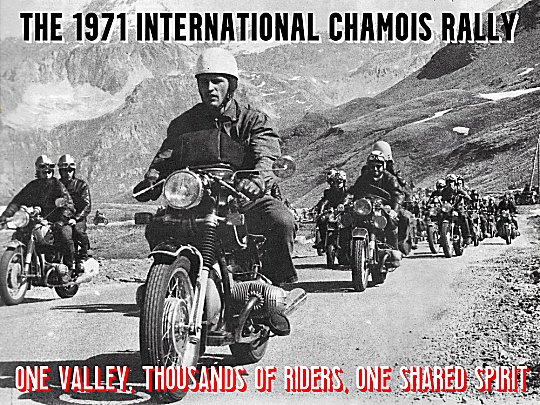
On Saturday 10th and Sunday 11th July 1971, the valley of Val d'Isère once again took on its most remarkable appearance for the seventh consecutive year. For one weekend, cars became almost a minority as thousands of motorcyclists converged on the upper Tarentaise Valley.
They came from every corner of France, but also from Italy, Switzerland, Sweden, Spain and several other European countries, all drawn by an event that had become an essential date on the motorcycling calendar: the Chamois Rally.
The journey begins
Organised once again by the BMW Club de France, under the direction of Jean Murit and M. de Seyne, the Chamois firmly established itself as one of Europe's premier motorcycle gatherings.
The approach to Val d'Isère was already part of the adventure. The higher the road climbed, the more motorcycles appeared. Every passing rider exchanged the traditional wave, a simple gesture that perfectly captured the spirit of the Chamois.
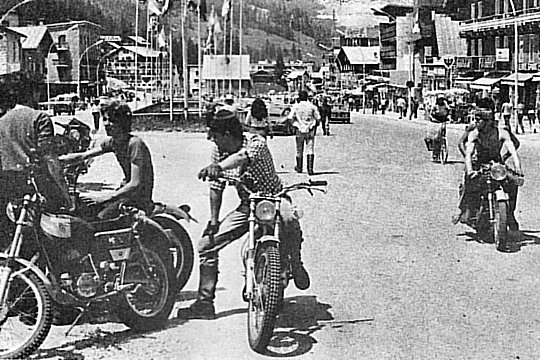
Bathed in bright sunshine, Val d'Isère took on a holiday atmosphere as riders relaxed in unusually warm conditions during the 1971 Chamois Rally.
The 1971 edition enjoyed almost perfect weather. Unseasonably hot temperatures prevailed throughout the weekend, encouraging many riders to swap their heavy leather jackets for much lighter clothing. Only a brief but violent thunderstorm on Saturday evening served as a reminder that, in the mountains, nature always has the final word.
As in previous years, the earliest arrivals began pitching their tents on Thursday. Campsites gradually filled as the more cautious riders enjoyed a little peace before the main influx.
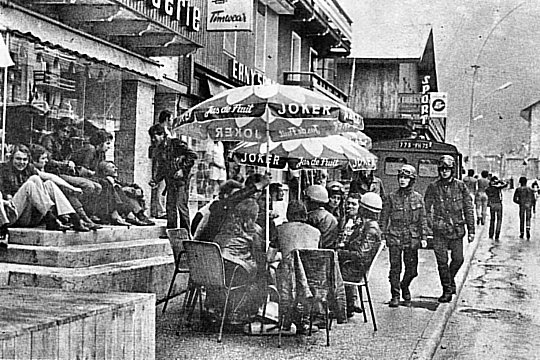
The café terraces of Val d'Isère often became the setting for reunions between friends who had met at motorcycle rallies across Europe.
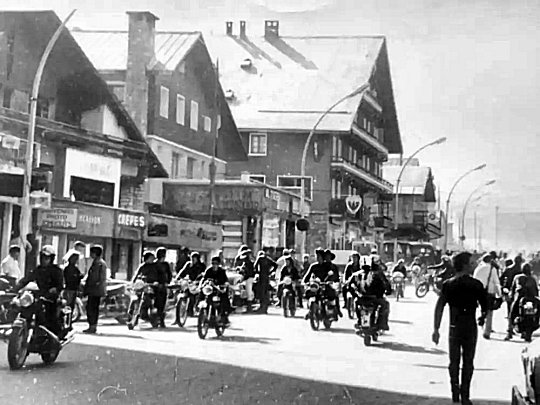
By Saturday morning, Val d'Isère had been transformed. The streets were packed with motorcycles, while the campsites welcomed thousands of participants in a remarkably relaxed and friendly atmosphere.
It was not uncommon to meet familiar faces hundreds of miles from home — friends encountered at other rallies throughout the year.
6,000... or 10,000?
As with many of the great motorcycle gatherings of the era, the exact number of participants remains open to debate. Contemporary reports published in the specialist motorcycle press estimated the attendance at around 6,000 people, while a documentary filmed during the weekend claimed that as many as 10,000 were present.
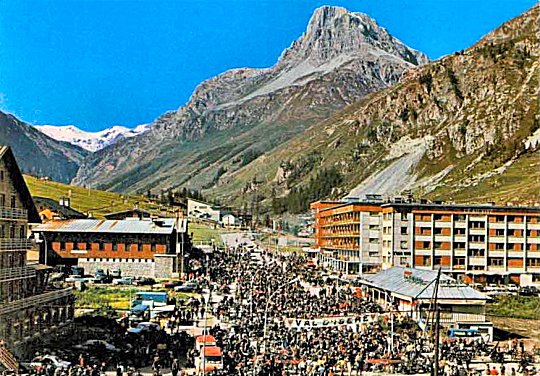
A sea of motorcycles fills the streets of Val d'Isère. Contemporary reports disagreed on the exact attendance, but all agreed that the 1971 Chamois was a truly remarkable event.
The discrepancy can probably be explained by the different methods of counting. Some figures refer only to officially registered riders, while others include passengers, visitors and the many spectators who came simply to witness the spectacle.
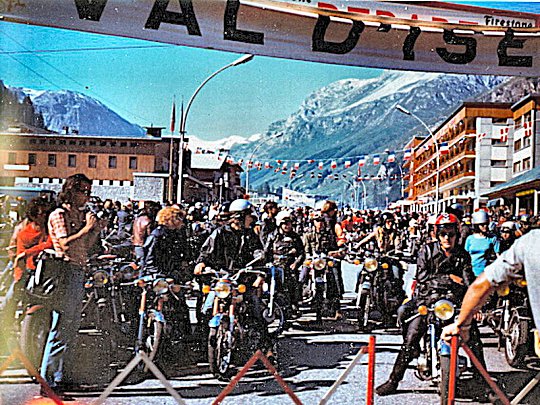
Beneath the Val d'Isère banner, riders from across Europe prepare for the rally's most eagerly awaited moment: the mass ascent of the Col de l'Iseran.
Whatever the true figure, one fact is beyond dispute: the 1971 Chamois attracted several thousand enthusiasts and ranked among the largest motorcycle gatherings in Europe during the early 1970s.
Despite this impressive turnout, several observers felt that attendance fell slightly short of expectations. Unlike the previous year, the 1971 Chamois took place over an ordinary weekend rather than a three-day public holiday, a factor that probably discouraged some riders from making the long journey to Val d'Isère.
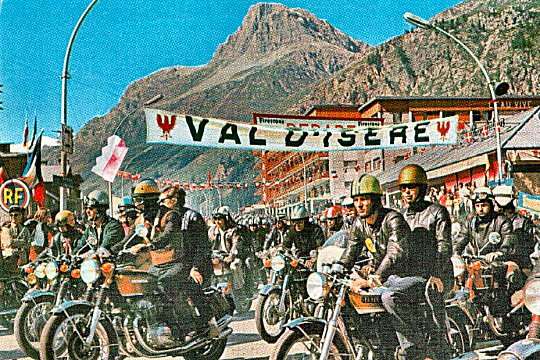
The legendary Sunday ride begins. Thousands of motorcyclists pass beneath the Val d'Isère banner before setting off for the traditional ascent of the 2,770-metre Col de l'Iseran.
Even so, this seventh edition further strengthened the rally's growing reputation and confirmed its status as one of Europe's best-established motorcycle gatherings.
The 1971 Chamois Rally on film
Photographs capture part of the atmosphere of the event, but moving images convey its true scale. Filmed in the heart of the 1971 Chamois Rally, the documentary below provides an exceptional record of this memorable edition. It shows the streets of Val d'Isère overflowing with motorcycles and, of course, the traditional climb to the Col de l'Iseran.
More than fifty years later, it remains one of the very few surviving film records of the 1971 rally.
Minor flaws, major success
The organisers had made significant improvements to the rally's facilities. New reception buildings at the entrance to the resort streamlined the registration process, while the enlarged parking areas coped effortlessly with the constant influx of motorcycles. The campsites, meticulously prepared in advance, were further evidence of the care and attention devoted to the organisation of the event.
For one weekend each summer, the fields around Val d'Isère became one of Europe's largest motorcycle campsites.
Nevertheless, a few criticisms remained. Several participants found the registration office difficult to locate, particularly the many Italian riders approaching Val d'Isère via the southern side of the Col de l'Iseran, who entered the village without passing through its main entrance.
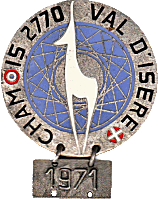
Others regretted that no official Chamois badge was issued that year, participants receiving only a dated souvenir plaque instead.
A handful of visitors also commented on the rather high prices charged by some of the local cafés and restaurants.
These minor shortcomings, however, did little to overshadow what was, by every other measure, an exceptionally well-organised rally.
The climb everyone came for
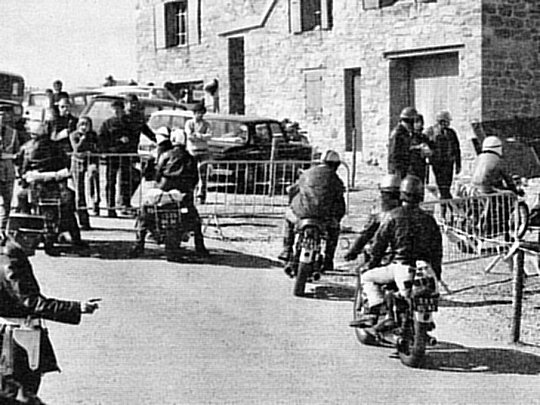
Without question, one of the highlights of the 1971 Chamois was the traditional mass ascent of the Col de l'Iseran on Sunday morning.
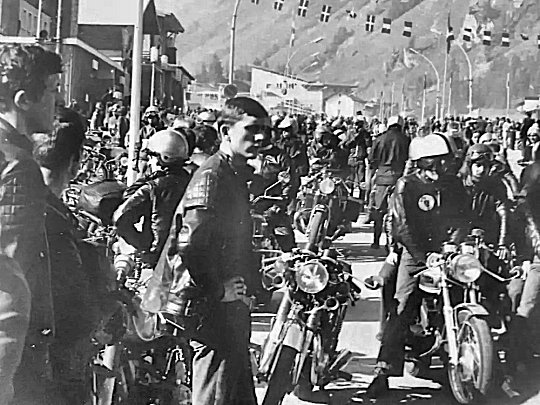
The calm before the climb. Riders gather in the streets of Val d'Isère, waiting for the start of the Chamois Rally's most eagerly anticipated tradition.
Carefully supervised by the French Gendarmerie and an efficient team of marshals, this spectacular procession of several thousand motorcycles created one of the most memorable sights of the entire weekend.
The French Gendarmerie ensured everything remained perfectly orderly — despite the best efforts of several thousand motorcyclists to prove otherwise.
Despite the sheer volume of traffic, the discipline shown by the riders impressed everyone present. Displays of excessive speed were few and far between, and the occasional over-enthusiastic rider failed to disturb the relaxed and friendly atmosphere that prevailed throughout the rally.
An endless procession of motorcycles climbing towards the Col de l'Iseran. Good manners proved considerably more popular than handfuls of throttle.
Even so, many participants felt that temporarily closing the road to cars during the ascent would have further improved both safety and enjoyment for the thousands of motorcyclists making the climb.
Where motorcycling worlds meet
The Chamois was far more than a motorcycle rally — it was a remarkable meeting place. Unlike many other gatherings where the same familiar faces appeared year after year, Val d'Isère attracted an extraordinarily diverse crowd.
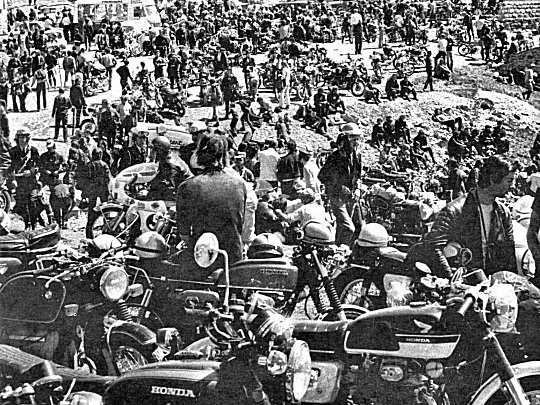
Grand Prix racers, trials riders, long-distance travellers, specialist journalists, collectors and everyday enthusiasts all mingled freely in an atmosphere where reputation mattered far less than a shared passion for motorcycling.
Among the thousands of participants were also a number of well-known personalities whose presence did not go unnoticed.
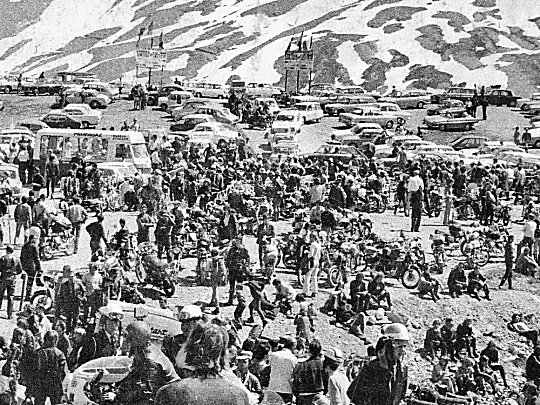
The Chamois 1971 had no VIP enclosure. World-famous riders, journalists, seasoned travellers and everyday motorcyclists all mingled freely among the crowds, exactly as they should.
The list was far too long to mention everyone, but one of the most recognisable visitors was George Moustaki, the celebrated French singer-songwriter of Greek origin, who arrived in Val d'Isère aboard his Moto Guzzi V7.
A towering figure of French popular music, Moustaki wrote more than 300 songs for himself and for many other artists, most notably Édith Piaf, for whom he penned the classic "Milord."
A lifelong motorcycling enthusiast, he loved travelling on two wheels and over the years owned an impressive succession of machines, including a Jawa 350, a Velocette Thruxton, a Moto Guzzi V7, and a Kawasaki 500 H1 Mach III.
For George Moustaki, motorcycles were more than a means of transport — they embodied the freedom and independence that shaped both his life and his music.
Other notable participants included competitors in the newly created Kawasaki Cup: Dominique Borredon, who rode for the Paris-based Kawasaki dealer Folie-Méricourt, and Jacques Gonthier, winner of the first two rounds of the new one-make championship.
Left: Dominique Borredon joins in a snowball fight at the summit of the Col de l'Iseran. Right: Jacques Gonthier, wearing a full-face helmet, on his Honda CB750.
Borredon had already made French motorcycling history as a member of the first all-female team to compete in a motorcycle endurance race.
In 1971, she partnered "Delphine" on a Kawasaki 250 in the 12 Hours of Montlhéry. Few spectators realised that the rider competing under the name "Delphine" was in fact Violaine Sanson, elder sister of the future French music star Véronique Sanson.
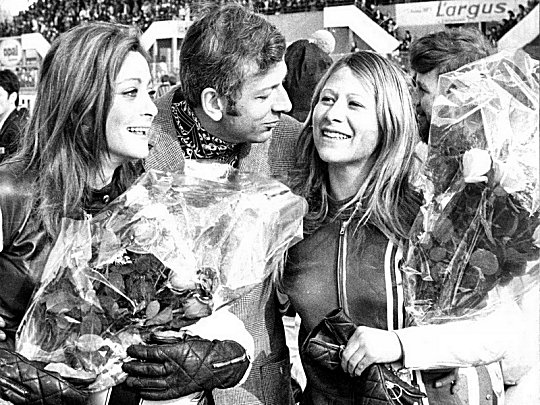
From left to right: Violaine Sanson; Hubert Robert, head of the workshop and race preparation department at Kawasaki Folie-Méricourt; and Dominique Borredon.
Their presence at the 1971 Chamois Rally also provides an opportunity to look back at the birth of the Kawasaki Cup.
Created in 1971 by Xavier Maugendre, head of SIDEMM, Kawasaki's official French importer, the one-make championship was heavily inspired by the highly successful Renault 8 Gordini Cup, launched two years earlier.
Backed from the outset by Moto Revue and its legendary editor Jean-Claude Bargetzi, the Kawasaki Cup would soon become one of France's finest training grounds for future racing stars, helping launch the careers of riders such as Patrick Pons and Christian Sarron.
From mopeds to masterpieces
Whether on the roads leading to Val d'Isère or in the streets of the resort itself, everyone mixed freely, regardless of the make of their motorcycle, its engine capacity or the reputation of its rider.
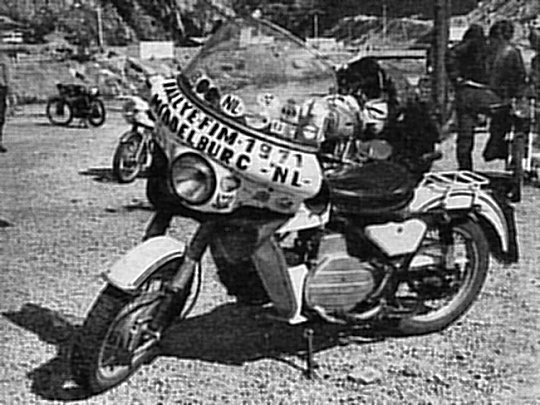
The fairing of this Moto Guzzi Nuovo Falcone reveals that its owner had competed in the FIM Rally at Middelburg, the Netherlands, held from 29 June to 1 July 1971, barely more than a week before riding to the 1971 Chamois Rally.
The motorcycles on display perfectly reflected that diversity. While modern touring machines made up the majority of the rally, it was often the more unusual bikes that attracted the greatest attention.
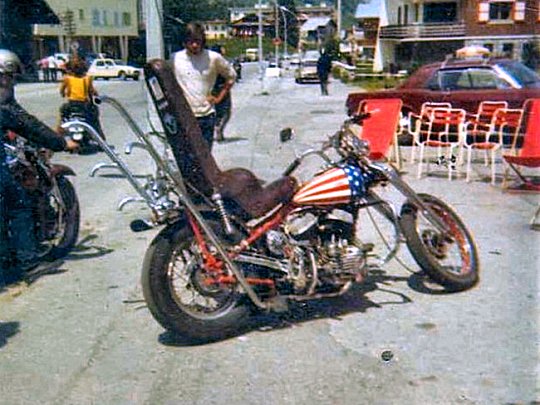
A replica of "Captain America", Peter Fonda's famous Easy Rider chopper, originally built by Cliff Vaughs and Ben Hardy from a retired 1952 Harley-Davidson FL Hydra-Glide.
A handful of choppers, several beautifully restored vintage motorcycles, an Italian-owned 1920s Indian, and a magnificent Gilera Saturno all served as reminders that the rich heritage of motorcycling was very much alive at the Chamois.
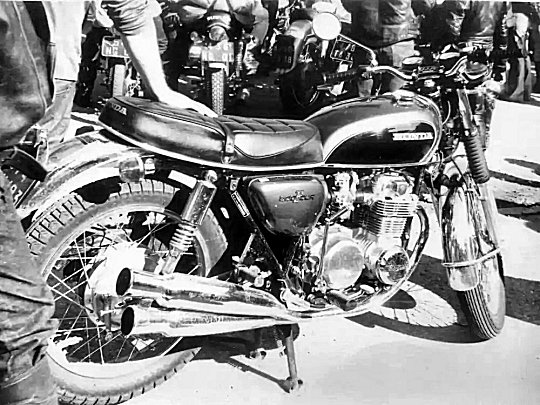
This Honda CB500 Four, photographed at the 1971 Chamois Rally, had been introduced to the European market just two months earlier, in May 1971.
At the opposite end of the spectrum, many young enthusiasts arrived on humble mopeds, courageously tackling the journey with their machines heavily laden with camping equipment and luggage — a powerful reminder that true enthusiasm for motorcycling has never depended on engine size.
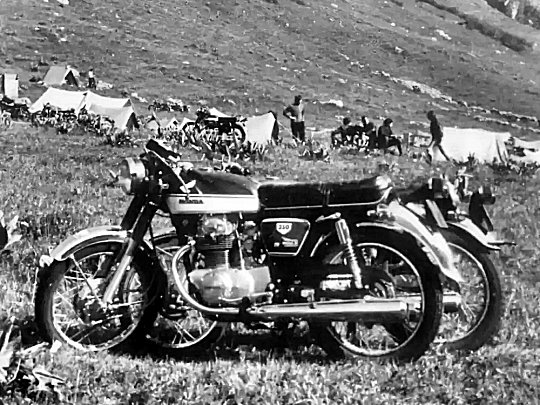
The 1970–71 Honda CB350, powered by its OHC parallel-twin engine, became one of Honda's greatest success stories, with more than 250,000 examples sold during its five-year production run.
The manufacturers were well represented too. Honda, BMW and Kawasaki all operated service facilities throughout the weekend, providing riders with free mechanical assistance and minor repairs, with participants paying only for any replacement parts required.
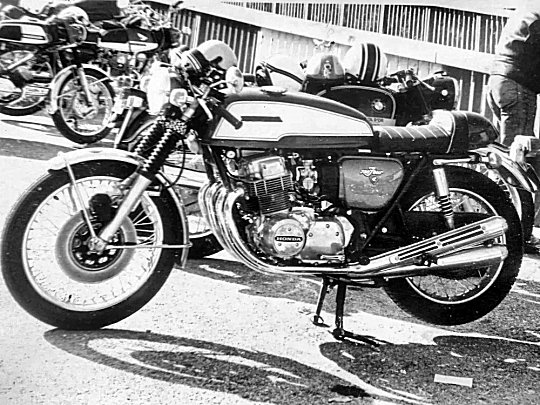
A Honda CB750 converted into a period café racer. Can any of our readers identify the manufacturer of the fuel tank and seat unit?
Honda, then rapidly expanding across the European market, used the rally as an ideal showcase for its growing commercial strength, with an especially prominent presence throughout the weekend.
More than just a rally
Following the traditional ascent of the Col de l'Iseran, another spectacle captured everyone's attention. Trials motorcycles took to the rocks, mountain streams and the last remaining patches of snow still clinging to the mountainside.
Left: The traditional Sunday morning climb to the Col de l'Iseran. Judging by the cameraman's technique, the phrase "don't try this at home" had yet to be coined. Right: Horsepower isn't everything. Reaching the summit on a VéloSoleX probably earned even more respect.
Bultacos, Montesas and Yamahas tackled the rugged terrain with astonishing ease, venturing where the large touring motorcycles could never hope to follow. Many saw in these displays the first signs of the remarkable boom that off-road motorcycling would soon experience.
At the summit of the Col de l'Iseran, the traditional climb finally came to an end as participants arrived at the Chapel of Notre-Dame-de-Toute-Prudence.
Yet beyond the motorcycles themselves, it was the atmosphere that left the deepest impression. Clubs displayed signs indicating their meeting points, friends reunited around the campsites and in the streets of Val d'Isère, sharing stories from the road and already making plans for the next rally.
For one weekend, Val d'Isère belonged to the motorcyclists, its streets filled with familiar faces, shared memories and plans for journeys yet to come.
Another striking feature was the growing number of women riders. Many had travelled to the Chamois on their own motorcycles, reflecting the rapid evolution of the motorcycling world at the beginning of the 1970s and the increasingly important role women were playing within it.
Like every major motorcycle gathering of the era, the Chamois was unfortunately not without its accidents, serving as a reminder that the mountains demanded both caution and respect.
Several participants also highlighted the need for improvements to certain sections of the road, particularly the Iseran Tunnel, in order to make future editions even safer.
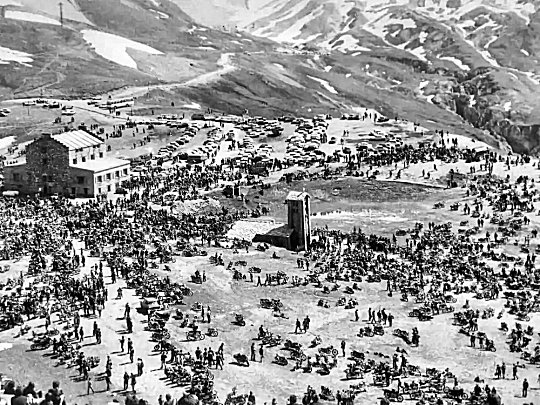
A breathtaking view of the 1971 Chamois Rally at the summit of the Col de l'Iseran. Few motorcycle gatherings could rival such a spectacular setting.
Despite these few reservations, the verdict was unanimous. The 1971 Chamois confirmed that it had become far more than just a motorcycle rally. It was a place where the joy of riding, the camaraderie of fellow motorcyclists and the breathtaking beauty of the Alps combined to create an atmosphere unlike any other.
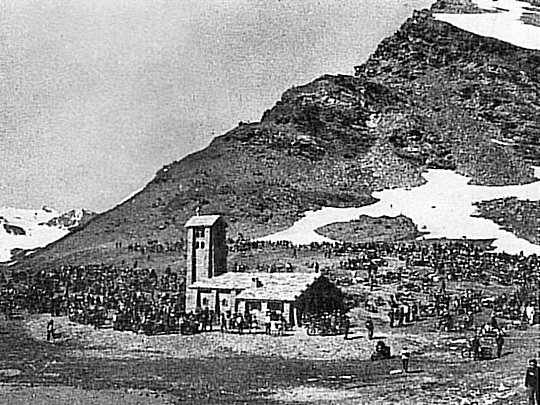
No grandstands, no podiums — just a tiny Alpine chapel, thousands of motorcycles and memories that would last a lifetime.
For the thousands of riders who gathered that weekend, the Chamois was not simply another rally. It had become an annual pilgrimage to the high mountains — a meeting place where friendship, a shared love of motorcycling and the grandeur of the Alps came together in perfect harmony.
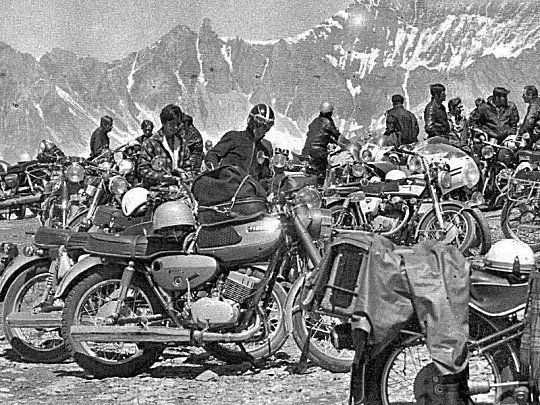
For thousands of riders, reaching the summit of the Col de l'Iseran was never the end of the journey — it was simply the promise of returning the following year.
As they left Val d'Isère, many already knew they would return the following year to climb the slopes of the Col de l'Iseran once again, adding another chapter to the story of one of Europe's most legendary motorcycle gatherings.
Text: Jean-Francois Helias
Photos: Gilles Gaudechoux & J.F Helias

Merci, Fanfan, pour cet article!
Même si je suis aujourd'hui moins passionné qu'autrefois, je lis toujours tes articles avec beaucoup d'intérêt. Malheureusement, mon cancer n'attaque pas seulement mes os, mais aussi les cellules de mon cerveau, ce qui ne m'aide pas à profiter des choses comme avant.
En tout cas, un grand merci à toi, et encore toutes mes félicitations pour le remarquable travail que tu accomplis.
Avec toute mon amitié sincère,


- Patrice Villard