ALL FOR
SPEED
AND SIDECARS
Speed 7
Chapter 7: Ariel Motorcycles
- John
In all I possessed five different Ariel models at different times. All had overhead valve four stroke pre-unit construction engines. All were finished in the ubiquitous Ariel Maroon paintwork and all except the 200cc LH Colt had the usual twin chrome fluted flashes on top of the petrol tank.
All of my Ariel’s had a dry multi-plate clutch. The three larger capacity machines had dry clutches operating outside of the primary chain case cover with the clutch body being covered by a separate slightly domed, chromium plated cover of its own which could be removed without losing any oil from the primary chaincase.
Another unusual feature of the Ariel’s was that the connection between the foot operated rear brake lever and the operating lever on the brake drum itself was via Bowden cable rather than the usual steel rod.
Ariel NH 350cc OHV Red Hunter
By the beginning of 1968 I was working for Wadkin’s Woodworking Machinery Co Ltd on Green Lane Road, Leicester. I was supposed to enter the apprentice school within the factory but the “school year” didn’t begin until August of that year so in the meantime I was set to work as a milling machine operator.
Another lad, also aged 16 who became a good friend was Johnny Kampf who had bought an Ariel NH 350cc OHV single from an older colleague.

This was a single cylinder overhead valve 4-stroke machine with swinging arm rear suspension and telescopic front forks. All of the cycle parts, including the frame, were painted the standard Ariel maroon with two chrome flashes on top of the petrol tank; one either side.
Johnny had bought the Ariel despite the fact that he was not able to ride it as he didn’t have a full licence. Neither did I at that time but I had a Watsonian Wobble Wheel sidecar and Johnny didn’t so we did an almost straight swap: I got Johnny’s Ariel plus a leather jacket and Johnny took possession of the Francis Barnett 197, which he could ride on L plates.
Did I pass on the warning not to brake whilst negotiating bends in the road? I can’t recall. In hindsight I seem to have got the better of the deal and would, if I could, equalize things retrospectively, by paying Johnny for the secondhand leather jacket at today’s value.
I later traded the leather jacket with Len, who then shredded it via several successive spills. The Red Hunter was transported from Johnny’s house on Uppingham Road to my house in Wigston on the back of a coal deliverer’s lorry.
It proved to be the only bike I ever owned with reliable, but nonetheless pathetic 6 volt lighting which produced a weak yellow candle like glow rather a than throwing a strong white beam forwards to illuminate the road for 100 metres or so ahead.
Cars had had 12 volt electrics since the mid 1950’s why not bikes?
Conveniently the Ariel frame already had sidecar lugs fitted as standard so I was able to hitch the “wobble wheel” sidecar chassis and blanket box to the bike one Saturday morning.
Wheel alignment was achieved using two long washing “line props”, one each side against the wheel rims of the bike wheels and the sidecar wheel, measuring the distance fore and aft between the two line props to achieve the recommended alignment.
There should be a “toe in of half an inch and the bike should lean out a couple of degrees. When motorcycle outfits were a more common sight it was not at all uncommon to see bikes leaning in towards the sidecar, which gives the rider a greater but false feeling of security, but it is wrong.
I took the outfit for its M.O.T test to Triangle Motors in Victoria Street, Wigston Magna. It failed spectacularly with so many faults that the examiner had to write out two fail certificates and staple then together.

Luckily the MOT tester did not comment on the lack of the fourth sidecar mounting arm. The tester complained that the sidecar wheel had no brake, which was not a legal requirement, so he couldn’t fail it on something which didn’t exist.
The faults and my remedies of them were:-
- Seat unsecured.
Tied down with fence wire, replaced PVC seat cover. - Petrol Tank unsecured.
Managed to insert at least 2 of the 4 bolts. - Audible warning system (horn) not working.
Fitted a bicycle bulb horn. - Rear brake Bowden cable frayed.
Replaced with a steel brake rod from a BSA. - Steering damper broken (he broke it).
Fitted second hand replacement from Bob Pike’s.
Back at home I remedied the faults as described above and took the bike back for a retest. The tester complained that the exhaust was too noisy, but he had to admit that that was not covered by the test, so he had to let it pass.
One Saturday I intended to visit a former school classmate in Fleckney where he lived but I only got as far as Aylestone Lane end of Willow Park Drive when I noticed a petrol tank leak with petrol dripping onto the hot exhaust pipe.
I was left with no option but to return home and cycle to Bob Pike’s motorcycle emporium at 141-143 Humberstone Road to buy a second hand petrol tank which was from an earlier model but at least it fit and didn’t leak.
I paid £5 for it.
A couple of days later, after I had fitted the replacement petrol tank, I rode out to Fleckney to see Roy who I had recently acquired a fairly ancient first generation 350cc BSA Gold Star.
I didn’t want to buy the Goldie as it was only 350cc and wouldn’t pull a sidecar, but I should have liked to have ridden it if only to compare its performance and handling with Peter’s B31, which had formerly belonged to Roy.
Roy promised me a trial ride on the Goldie if I first let him have a ride on my Red Hunter and sidecar. Roy had not ridden a motorcycle and sidecar before but he had a full licence so he thought that he was adequately qualified and experienced to ride anything and everything.
We headed towards Saddington with Roy at the helm and me on the pillion seat.
We couldn’t have been doing much more than 55 mph, which was approaching the top speed of the solo geared outfit, when on the other side of the road a Midland Red bus was approaching from the direction of Saddington heading towards Fleckney.
The road was adequately wide enough for two vehicles to pass in opposite directions and there was even a broken white line down the middle of the road, but Roy panicked and steered off to the left with the bike wheels close to the gutter as if he was riding a solo with the sidecar wheel bumping along the top of the grass verge.
A wooden telegraph pole stood in the middle of the grass verge directly in line with the sidecar but Roy made no attempt to avoid it.. The blanket box hit the telegraph pole, ripping it from its mounting bolts, the rebound sending the blanket box backwards towards Fleckney.
The progress of the chassis was arrested when it collided with the telegraph pole swinging the bike around the far side of the pole to end up nose down in a ditch full of water and stinging nettles with Roy still on board clinging on to the handlebars like grim death.

Meanwhile I had been launched skywards over Roy’s head and was projected head first some metres above the road towards Saddington.
My flight seemed to be in slow motion and I remember thinking to myself that if I didn’t turn myself around to be feet first and land on my back, my head could end up hitting the road surface.
Somehow I performed a perfect 180 degree forward somersault and landed on my back with my feet facing towards Saddington but the air knocked out of my lungs.
A Fleckney bound motorist who had been following the bus and had seen the accident stopped his car and ran up to see if I was still alive.
“Are you OK? He asked.
I couldn’t reply to his question immediately as I couldn’t remember if I had last breathed in or out before impact and so didn’t know whether to breathe in or out to regain by breath.
Fortunately I was undamaged and so was Roy as we scratched our heads and surveyed the wreckage.
We placed the still intact blanket box back on top of the chassis and I was able to ride the seriously misaligned outfit back to Roy’s house in Fleckney where I dropped him off and rode slowly and cautiously back to Wigston and home, forgetting all about the Gold Star, which Roy had decided that I wasn’t going to get to ride in any case.
Back home I realigned the bike and sidecar which handled better after the accident than it had done before the accident.
Penny washers were fitted to the mounting bolts of the blanket box and all was restored, but I never went back to Fleckney ever again.
The Red Hunter started reliably first kick and was one of the few bikes I owned which had reliable electrics.
As with many tall single cylinder engines it was fitted with “Hairpin” valve springs to reduce the height of the engine and the depth of the cavity beneath the petrol tank, enabling a larger fuel capacity than would otherwise be possible.
Not that I have studied or scrutinized female hairpins closely but I would say that the term “hairpin” is something of a misnomer as to me the motorcycle “hairpin” valve spring more resembles the spring of a clothes peg. Clothes Peg Valve Springs.
The original mudguards of the Ariel Hunter were heavily valenced painted steel so to make the bike look sportier I exchanged the original mudguards for a pair of polished aluminium mudguards from Eros Motors, but I didn’t use shakeproof nuts and bolts to mount them.
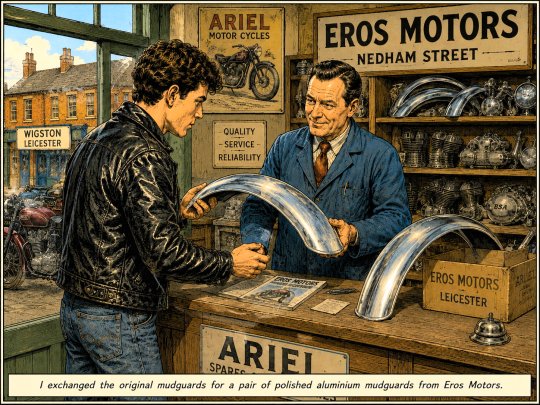
Riding quite rapidly from the Pork Pie Library along Stonesby Avenue to cross over the Blue Bridge into Aylestone Lane, Wigston, my rear mudguard dropped onto the tyre of the rear wheel and rotated with the wheel until its rotation was arrested by the rear number plate hitting the back of the dualseat.
What should have been the leading edge of the new rear mudguard ended up sandwiched between the tyre and the road, making a terrible scraping noise and doing the finely polished surface of the new mudguard no good at all.
“That’s clever” I thought “I have just managed to run over my own mudguard”.
The outfit scraped to a stop using the front brake only, the rear wheel being already static.
Extricating the rear mudguard from beneath the rear wheel, I posted it under the lid of the blanket box with just the rear number plate visible.
A passing dog walker (there’s always one) voiced his opinion of youth in general and me in particular, all of which I ignored.
That was the last outing of the Red Hunter outfit which I mothballed.
Ariel 500cc VH Red Hunter
Since 1962, aged 12, I had seen this 1951 rigid framed VH Red Hunter in its original unrestored condition on the way to school, leaning against the back wall of a council house on the corner of Rolleston Road and Orson Drive, Wigston and languishing under a tarpaulin.
By the age of 16 or 17 I had gathered enough courage to knock on the door of the house and enquire if the bike was for sale.
The lady I spoke to told me that the bike belonged to her brother who lived in Holmden Avenue.
The brother asked only 30 shillings for the bike on account of it having a broken clutch.
I didn’t quibble, paid the 30 bob and wheeled the bike home.

On closer inspection I found that the clutch was fine and only the primary drive chain had broken.
That was easily remedied as I had a store of used roller chains.
For the life of me I cannot recall what finally happened to the Ariel VH, only that I never rode it.
If only I had it now I would treat it kindly, leaving it in the condition in which I found and bought it and ride it to old timer events or donate it to a museum.
All of my youthful efforts to make every bike modern and sporty were futile as they never improved performance or reliability one iota...
Ariel 200cc LH Colt
A work colleague offered me this 1957 machine virtually in kit form in exchange for a transistor radio and a sword stick which had been a family heirloom for generations of my Dad’s family and consisted of a narrow square section blade concealed inside a hollow bamboo walking cane.
I don’t know how my Dad came by the sword stick, only that I wanted to get rid of it.
The Ariel Colt had a plunger frame with telescopic front forks, coil ignition, a 4 speed gearbox and the engine and cycle parts were very similar in appearance to the 250cc BSA C11.

I assembled everything including the contents of the gearbox, which for me was unknown territory.
Actually I rebuilt the gearbox twice as on the first completion there was one vital part still left in the cardboard box.
As I didn’t have any oil or petrol to hand I never got it to run.
To be honest I lost interest because it was plunger frame and was not big enough to pull a sidecar, so I swapped it back with the original owner in exchange for a mains valve radio which turned out to be rubbish.
Ariel Square 4 1000cc
On my perambulations around the city and county I was always on the lookout for my interesting motorcycles with an out of date tax disc, indicating that they were not in current use and may be for sale.
Cycling through Groby, on the waste ground behind a row of cottages called The Rookery (since demolished) there stood an unidentified motorcycle and sidecar which, from the rear view, appeared to be a BSA A7 or A10, but on closer inspection it turned out to be a 1959 1000cc Ariel Square 4 with plunger rear suspension, a huge 1 gallon oil tank and an S.U. carburettor of a type usually found on British family cars of the period.
The Square 4 was quite some find and I was very excited about it.
Enquiring at the first cottage, an old lady told me that it belonged to John Brown, a quarryman who lived in one of the middle cottages.
I knocked at John Brown’s back door (I don’t think that there was a front door) and his young blonde wife answered it.
I told her that I was interested in the outfit and she invited me into the cottage to wait for her husband to return from work.
As soon as John arrived we went to look at the machine and to fix a price.
He asked for £15, which was very reasonable, so I did not haggle.
He told me how he had raced the bike solo around Mallory Park Racing Circuit which was obviously rubbish as the tread of the tyres had worn flat and square in section due to years of sidecar use.
The Ariel Square 4 is a heavy sidecar tractor, not a racing machine, but it is rapid enough.
I took it for a test ride across Ratby Road into Crane Ley Road directly opposite the cottages, and then right into Chapel Hill, which is a cul-de-sac.
The bike went well, in fact it flew.

I did a smart u-turn at the end of Castle Hill and sped off back towards The Rookery.
Attempting to slow down for the Ratby Road tee junction I found that the brakes in the full-width aluminium hubs had seized up solid in the off position.
Changing down rapidly through the gears I used the engine compression as a brake and managed to pull up just in time.
I hadn’t any money on me at the time so we arranged an appointment for me to come back with the cash and for me to collect the bike.
On the appointed day Len and I arrived on foot at the Brown’s cottage with the cash and a gallon of petrol in a can.
John Brown’s wife opened the door to us and invited us into the kitchen before she disappeared deeper the cottage, leaving us to wait for John to descend the steep back stairs.
The money changed hands; the petrol was tipped into the tank of the Square 4 and Len and I rode the outfit back to Len’s house where I dropped him off and continued on to Wigston.
The Square 4 was a shade under 1000cc but it was easy to kick start.
The choke was operated by a brass lever attached directly to the underside of the SU carburettor.
I don’t know why I never rode it on the road again, perhaps because of the old man image of the rear plunger type suspension.
Only a few examples of the 1960 model had a swinging arm rear suspension and that was the last year that Ariel produced the square 4. (The first had been in 1931).
I sold the bike as a solo for £20 to a lad at Carlton Drive end of Willow Park Drive who usually rode a Simson 50cc bike with an expansion chamber exhaust.
He had the Square 4 painted metallic light blue.

Sometime later, in my early twenties I came across a pair of Square 4’s in the small front garden of a terraced house in a street off Narborough Road, Leicester leading down to the former Great Central Railway line.
One was a 1938 600cc and the other was a 1949 1000cc, both with only two exhausts pipes.
The owner offered me the pair for the odd price of £10.50p.
I was tempted but then thought - Do I really want or need two Square 4’s?
Where would I keep them?
What would I do with them?
How would I justify the expenditure to my girlfriend?
So with some regret I didn’t buy them.
Ariel FH Huntmaster 650cc
In 1970 I bought my last outfit which was a 1958 Ariel Huntmaster 650cc parallel twin, from an impoverished student in St Leonards Road, Clarendon Park, close to Leicester University.
During a lunchbreak from work I and a workmate named Bill walked the mile or so from the garage to the address to view the machine.
I took the outfit for a fast test run up the slight incline of St Leonards Road with cars parked all along the left hand side.
At the crossroads with Montague Road I performed my party trick of turning the outfit around in the available roadspace without reducing speed by inducing an intentional controlled spin with all thrree wheels sliding across the road surface.
Bill later told me that the seller was astonished by the manoeuvre and had concluded “He’s mad!”
From fading memory I paid no more than £30 for the outfit.
I hadn’t the money on me at the time of viewing and had to wait until Friday pay day when I returned with the cash and the insurance certificate and drove me and Bill back to work.
Third Party Only insurance for this 650cc motorcycle and sidecar, which also insured me to ride any other bike that was not registered in my name, was £6.50p per annum.
Road Tax was £10 per annum, Petrol 6/6d (33p) a gallon (4.5 litres) or 1/5d (7.5p) per litre.
I was earning about £18 a week at that time.

The paintwork was again the standard Ariel maroon with the tank sporting the twin chrome flutes.
The deeply skirted dualseat was the standard Ariel beige.
The Ariel 650cc twin engine was a disguised BSA A10 engine, having a different timing case and rocker box covers.
Coincidentally, like my former BSA A7, the Huntmaster had odd Gold Star type silencers.
This time I solved the problem of the odd exhaust notes by hacksawing the end of both silencers off, producing a matched pair of open megaphones.
The sound was incredible and in town I was forced to chug along slowly in top gear so as not to attract unwanted attention.
Call me Hermann Boring if you like but I never did exceed speed limits in built up areas.
My mother was not impressed with the modified exhaust and complained about the din I made when returning home late at night, when the engine noise woke her up.

In an attempt to alleviate the nuisance I cut the engine at the top of our hill and coasted downhill to our house in neutral.
Turning sharp left into our driveway, which was inclined upwards from the road, the sidecar wheel lifted as I braked to avoid hitting the garage doors, tipping me sideways into the privet hedge separating our drive from next doors.
The next morning I asked my mother if she had found my silent approach any better.
Mother said that the lack of engine noise was a definite improvement, but otherwise “I have never heard such bad language in all my life”. (Referring to my negative comments from the hedge).
I didn’t like the form of the handlebars on the Huntmaster so I shortened them which lessened the leverage and made handling the outfit harder work.
Then the throttle cable snapped so I substituted the choke cable and lever making the twistgrip redundant.
Next the clutch cable broke so I had to get the outfit rolling in a novel manner.
Standing at the side of the stationary outfit with the engine running in neutral gear I would push the outfit to a fast walking pace, leap aboard, kick the gear lever into first gear and open the throttle with the choke lever.
Once in motion changing gear without the clutch was not a problem. The parents of a girlfriend understandably forbade me from taking their daughter anywhere on the oil stained outfit so we had to take the Corpo bus into town for nights out.

It soon dawned on me that I couldn’t afford a girlfriend and a motorbike and that I would have to make a choice between one or the other.
I made the wrong choice and sold the bike (only) to a former workmate who lived in Syston and was an Arial fanatic had bought a lot of Arial parts from A E Milne’s on Uppingham Road, including a unique prototype pre-unit Arial 750cc parallel twin.
It was requested that I dismantle the Huntmaster so that it could transported to Syston in the back an estate car.
The buyer was especially interested in the wheels of the Huntmaster which had full width aluminium hubs.
The wheels, engine and gearbox went first and I was told by the buyer that he would return shortly for the frame and forks.
One evening I got home from work to find the frame and forks gone.
I asked my Dad if the buyer been over again and had taken them away?
“No” replied my Dad, “They’d been lying in the garage for ages (days) and I thought you didn’t want them so I took them to Dobbo’s scrapyard on the way to work”.
“Dad! I’ve sold them to somebody. What am I going to tell him when he returns to collect them?”
Fortunately the buyer never returned.
- John Ellis
Additional illustrations by Jean-Francois Helias